Dark Matter During Star Formation
A self-contained derivation of the dark-matter density profile that adiabatic contraction builds around a forming star - why it is a power law, why the exponent is 3/2 and not 9/4, what a supernova does to it, and what it means for the debate over dark-matter spikes around stellar-mass black holes.
Glossary and prerequisites
Assumes classical mechanics (action-angle variables) and introductory statistical mechanics. The astrophysics terms used below:
- Distribution function
- the density of particles in phase space (position-velocity space). For an isotropic system it depends only on energy . The real-space density is its velocity integral, . - Phase space - the 6D space of positions and velocities
. Liouville’s theorem: is conserved along orbits, so it is invariant under slow (adiabatic) changes of the potential. - Isotropic velocity distribution - velocities have no preferred direction; equivalently a full, unbiased spread of orbital eccentricities. A Maxwellian is the thermal (Gaussian-in-velocity) isotropic case.
- Virialised halo - a self-gravitating system in equilibrium, obeying the
virial theorem
; its particles have random (not ordered) velocities. - Adiabatic invariant - a phase-space integral (
, ) conserved when the potential changes slowly compared to the orbital period. - Cusp / spike - a power-law central density rise,
. “Spike” usually denotes the steep enhancement around a compact object. - Loss cone - the region of the orbit-space whose pericentres reach the central object; such orbits are captured and removed.
- Collisional relaxation - slow evolution of orbits from cumulative two-body
gravitational encounters, characterized by a relaxation time
. - Fokker-Planck / detailed balance - the diffusion equation governing
under relaxation; its stationary state is fixed by the balance of drift and diffusion (fluctuation-dissipation). - Dynamical friction - the drag a massive body feels moving through a background of lighter particles (here, DM), which it gravitationally focuses into a trailing wake.
- EMRI - extreme-mass-ratio inspiral: a compact object spiralling into a much larger black hole, a key gravitational-wave source for LISA.
0. The question
A star forms inside a dark-matter (DM) halo. Initially the DM is spread out in an
approximately uniform density profile,
The questions we answer here, from first principles:
- What is the final DM density profile ? (It is a power law,
.) - What is the exponent
? - Why do two standard methods give two different answers -
and ? - What survives a supernova, and what survives billions of years of stellar scattering?
- What does all this say about whether observed DM spikes imply primordial black holes?
The punchline for (2)-(3): the answer depends entirely on what orbits the DM particles
are on. Circular orbits give
1. The tool: adiabatic invariants
When a system’s potential changes slowly compared to the orbital period of a particle (the adiabatic regime), certain phase-space integrals are conserved. For a particle in a spherical potential the two relevant adiabatic invariants are:
where
Two limits use these differently, and that is the entire origin of the
2. The circular-orbit model (Blumenthal et al. 1986)
The simplest and oldest prescription assumes every DM particle is on a circular orbit.
A circular orbit has
is conserved for each shell, where
Derivation of the slope
Start from a uniform sphere,
Mass conservation shell-by-shell,
More generally, for an initial cusp
The figure below shows a numerical implementation: a uniform profile is contracted through
successive stages and the inner slope locks onto
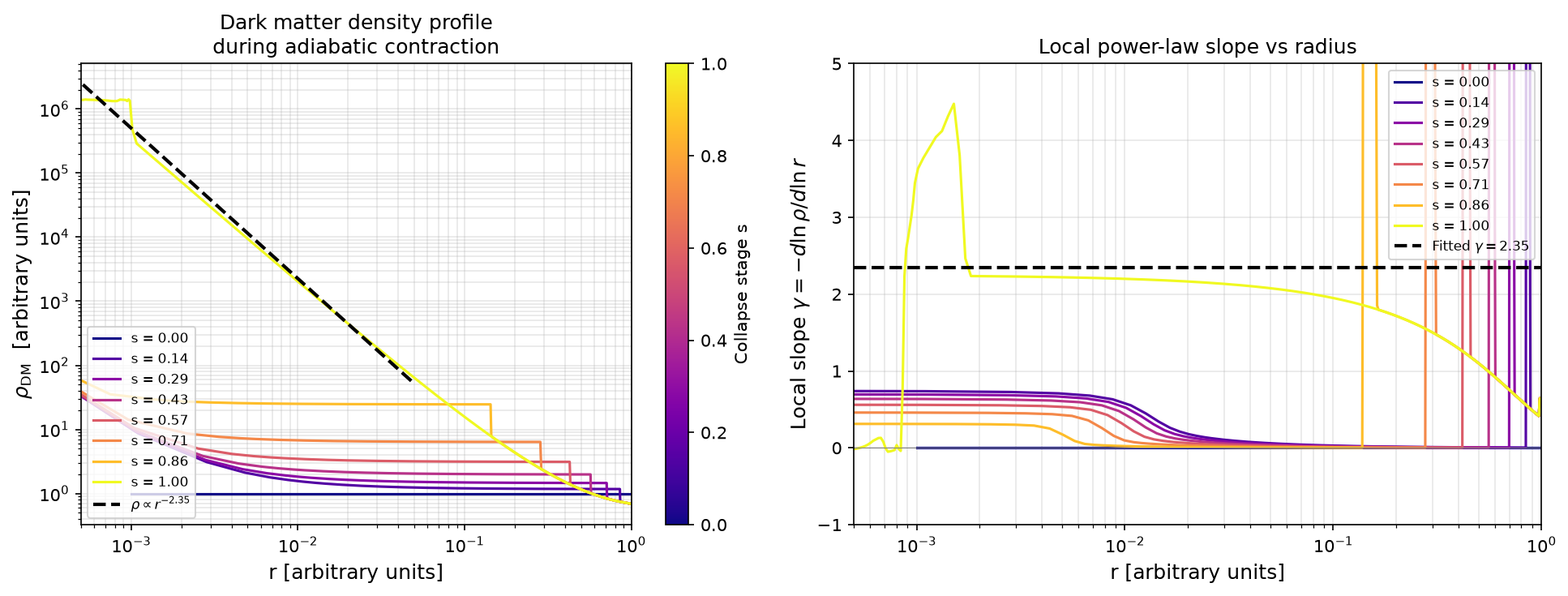
** But circular orbits are a fiction.** Real DM in a virialised halo has an isotropic velocity distribution - a full spread of eccentricities. That changes the answer.
3. The Liouville / phase-space model (Young 1980)
Now we do it honestly. The DM starts with an isotropic Maxwellian velocity distribution
inside the uniform sphere. We conserve the full adiabatic invariants
The initial potential is harmonic
A uniform sphere of total density
For the harmonic oscillator the radial action has a closed form:
The final potential is Keplerian
After the baryons collapse to a point mass
Equate the invariants - and
Setting
This is an exact, analytic map from a particle’s initial energy to its final
Keplerian orbit - no time integration required. The final semi-major axis is
Why the density goes as
Here is the crucial kinematic fact. In a Keplerian potential a particle at small
radius moves fast:
This
This is the result of Young (1980) and, in the DM-during-star-formation context, Capela, Pshirkov & Tinyakov (2014) (arXiv:1403.7098).
Numerical confirmation
In order to get a numerical confirmation, we have created a script that samples
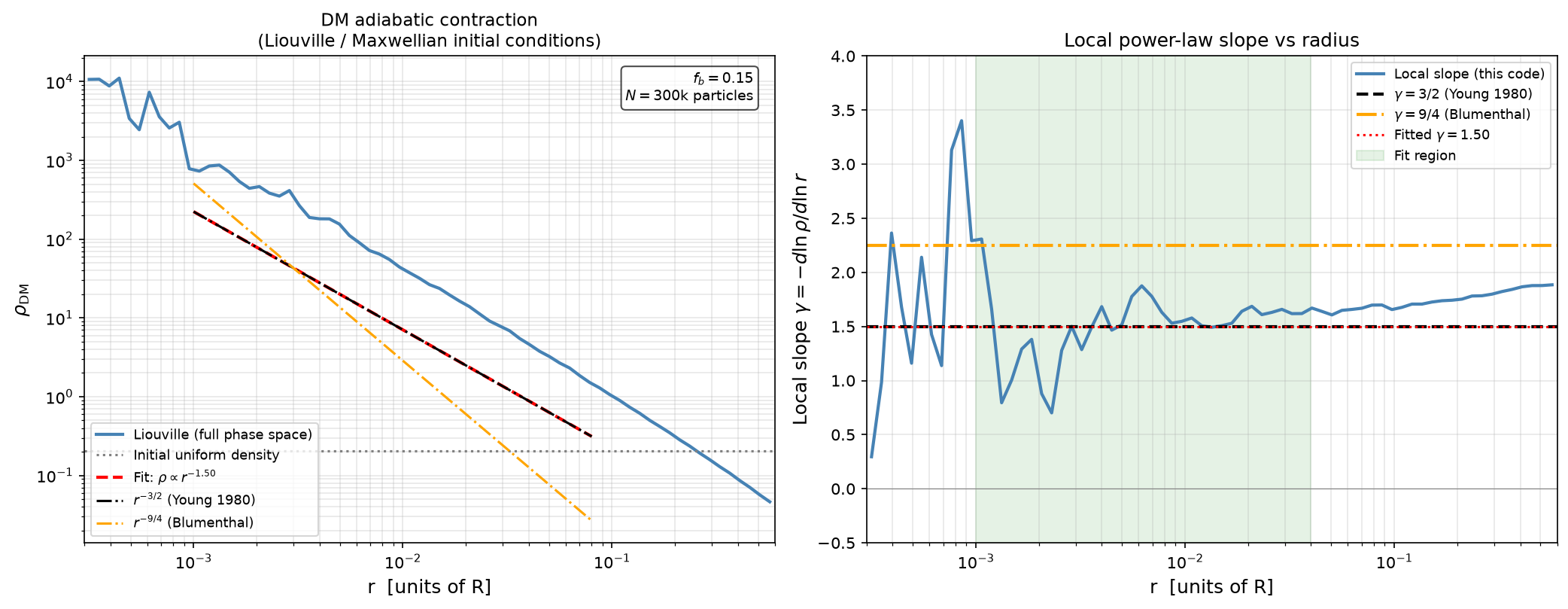
4. Why
The two models conserve different things because they assume different orbits:
| Circular (Blumenthal) | Eccentric / isotropic (Liouville) | |
|---|---|---|
| Conserved | ||
| Each particle occupies | a fixed radius | a range |
| Density at | the one shell mapped to | time-averaging of many orbits |
| Result |
The one-sentence version: the circular model pins each particle to a radius; the Liouville model puts each particle on an orbit, and an eccentric particle spends most of its time near apocenter - far from the center - which dilutes the inner density and makes the cusp shallower.
Interpolation. If you allowed only orbits up to some maximum eccentricity
A cleaner bookkeeping: slope ↔ distribution function
For an isotropic population in a Keplerian potential with distribution function
So
5. General-relativistic corrections
The Newtonian
- Loss-cone cutoff (dominant). Any DM particle whose pericentre falls inside
the innermost stable circular orbit is captured. For Schwarzschild,
. The spike is simply truncated below : there, outside. - Black-hole spin. For a maximally spinning Kerr hole,
, six times smaller. Since , the density at the inner edge is enhanced by - a large factor for annihilation or gravitational-wave signals. - The asymptotic slope is unchanged. The GR correction to the effective potential enters
at
, so ; in the observable region the slope .
The GR-consistent Schwarzschild treatment (Sadeghian, Ferrer & Will 2013) confirms the slope is preserved outside the loss cone with a modest inner-normalisation change.
6. What a supernova does: the slope is invariant
Most stars that leave a compact remnant explode first, ejecting a mass fraction
It escapes if
where
Only the normalisation drops (down to
I have created a script to confirm this: the remnant slope stays pinned at
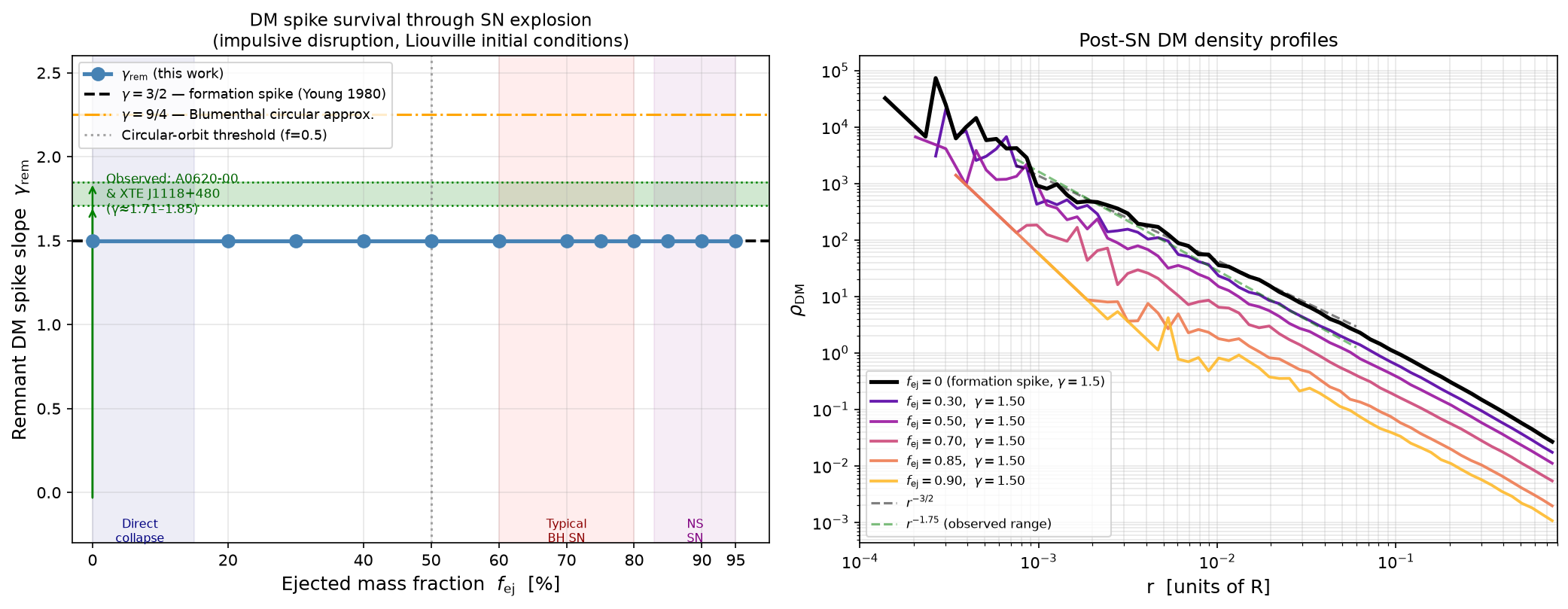
The same invariance holds for adiabatic re-accretion of fallback material:
Keplerian-to-Keplerian mass growth rescales every orbit by a common factor and
leaves the slope untouched. Neither impulsive mass loss nor subsequent accretion
can move
7. Billions of years later: stellar scattering and the Bahcall-Wolf attractor
Over cosmic time the DM cusp is stirred by two-body gravitational encounters with stars - collisional relaxation. Bahcall & Wolf (1976, ApJ 209, 214) solved the energy-space Fokker-Planck equation for stars around a massive black hole and found a steady-state attractor: a constant-flux cusp
independent of initial conditions. In our
Their 1977 sequel (ApJ 216, 883) and Alexander & Hopman (2009) treat multiple
masses: heavy species keep
| Regime | What scatters the DM | Attractor | |
|---|---|---|---|
| DM self-relaxation (single mass) | DM-DM | ||
| DM as light species | heavier stars |
Emulating relaxation
Rather than solve the full Fokker-Planck PDE, we have emulated relaxation with a
stochastic (Langevin) process engineered to have the correct stationary
distribution. Working in binding energy
Reflecting boundaries represent resupply by the outer halo and the inner loss cone. The result: both formation slopes converge to the attractor, erasing the memory of the initial condition.
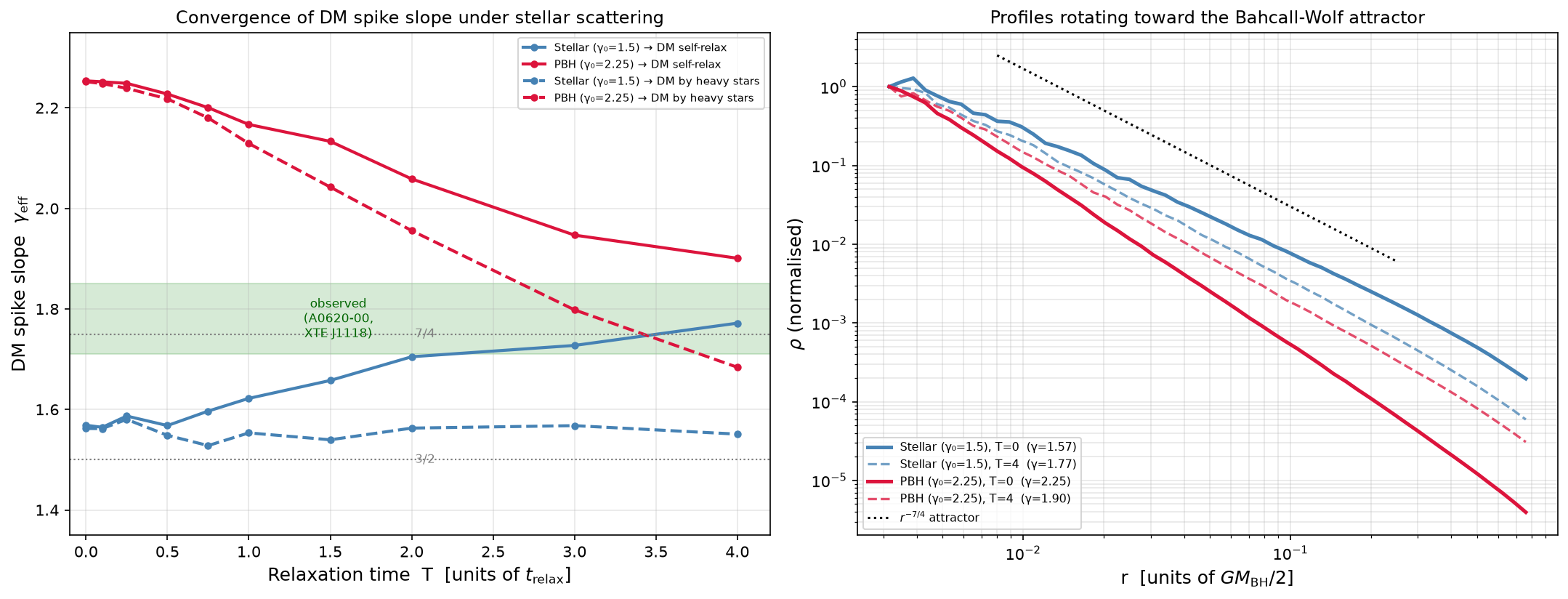
(Caveat: this is an illustrative model whose equilibrium is set by construction - it correctly captures the direction, rate, and endpoint of relaxation, but it is not a first-principles Fokker-Planck solve. For a paper one would cite/use the Alexander-Hopman coefficients.)
The physically important corollary: because DM is much lighter than stars, the
relevant attractor is the mass-segregation one,
8. The payoff: do observed spikes imply primordial black holes ?
Several black-hole low-mass X-ray binaries (A0620-00, XTE J1118+480, Nova Muscae
1991) show anomalous orbital-period decay that has been attributed to dynamical
friction against a DM spike. Because a light black hole formed by stellar
collapse is “not expected” to carry a spike, some authors (e.g. arXiv:2406.07624)
argue the primaries could be primordial black holes, which form dense
secondary-infall spikes with
Two things sharpen this:
-
How steep must the observed spike be? An N-body analysis with feedback (arXiv:2510.11635) finds the friction requires
-
How steep can a stellar-origin spike be? Everything above gives a hard ceiling:
- Formation (Young/Liouville):
. - Supernova: preserves it exactly.
- Fallback accretion: preserves it (Keplerian rescaling).
- Relaxation: mass-segregation drives DM toward
; self-relaxation caps at .
- Formation (Young/Liouville):
The verdict
There is a clean gap: a stellar-origin black hole cannot exceed
Honest caveats. (i) This confirms, rather than overturns, the prevailing assumption. (ii) The whole edifice is contingent on the period decays being due to DM at all, which is contested. (iii) The relaxation ceiling should be nailed with real Alexander-Hopman coefficients, not the toy. (iv) One genuinely open effect could change the picture: the natal kick.
9. The open problem: natal kicks
A supernova imparts a kick velocity to the newborn compact object (from asymmetric ejecta and neutrino emission), typically tens to hundreds of km/s. This moves the black hole out of the center of its own DM spike. Unlike the symmetric mass loss of §6 - which we showed preserves the slope - a kick displaces the potential minimum relative to the frozen DM, and could:
- strip the spike almost entirely if the kick exceeds the DM orbital velocities, or
- leave a lopsided remnant cusp that the black hole slowly re-captures.
Neither the primordial-origin papers nor the pipeline here has modelled it, and it
is the one ingredient that could move
10. Summary
| Stage | Mechanism | Effect on slope |
|---|---|---|
| Formation (circular approx.) | Blumenthal | |
| Formation (isotropic, correct) | Liouville / Young 1980 | |
| Supernova (mass loss) | impulsive, scale-free | unchanged |
| Fallback accretion | Keplerian rescaling | unchanged |
| Relaxation (DM by stars) | mass-segregation | |
| Relaxation (DM self) | Bahcall-Wolf | |
| Stellar-origin ceiling | - | |
| Observations require | dynamical friction (N-body) | |
| Primordial (secondary infall) | Bertschinger 1985 |
The DM density profile built during star formation is a power law because
the final potential is Keplerian; its exponent is
how to cite
if this post was useful in your work, please cite it. Two guidelines:
Plain text:
Capela F. (2026). Dark Matter During Star Formation: How a Uniform Halo Becomes a Spike. Available at: https://labfab.io/blog/dark-matter-halo
BibTex:
@misc{capela2026dmspikes,
author		= {Capela, Fabio}
title		= {Dark Matter During Star Formation:How a Uniform Halo Becomes a Spike},
year 		= {2026},
howpublished    = {\url{https://labfab.io/blog/dark-matter-halo}}
}
References
- Blumenthal, Faber, Flores & Primack (1986), ApJ 301, 27 - adiabatic contraction, circular-orbit model.
- Young (1980), ApJ 242, 1232 - phase-space adiabatic growth,
. - Bahcall & Wolf (1976), ApJ 209, 214 - the
relaxation cusp. - Bahcall & Wolf (1977), ApJ 216, 883 - multi-mass / mass segregation.
- Blaauw (1961), BAN 15, 265 - impulsive mass-loss disruption threshold.
- Bertschinger (1985), ApJS 58, 39 - secondary infall, self-similar
. - Gondolo & Silk (1999), PRL 83, 1719 - spikes around massive black holes.
- Sadeghian, Ferrer & Will (2013), PRD 88, 063522 - GR-consistent spike.
- Alexander & Hopman (2009), ApJ 697, 1861 - strong mass segregation.
- Capela, Pshirkov & Tinyakov (2014), arXiv:1403.7098 - adiabatic contraction & primordial black holes.
- arXiv:2406.07624 - primordial-origin interpretation of X-ray-binary spikes.
- arXiv:2510.11635 - N-body critical assessment;
requirement.